

Carbon pathways into
advanced energy materials.
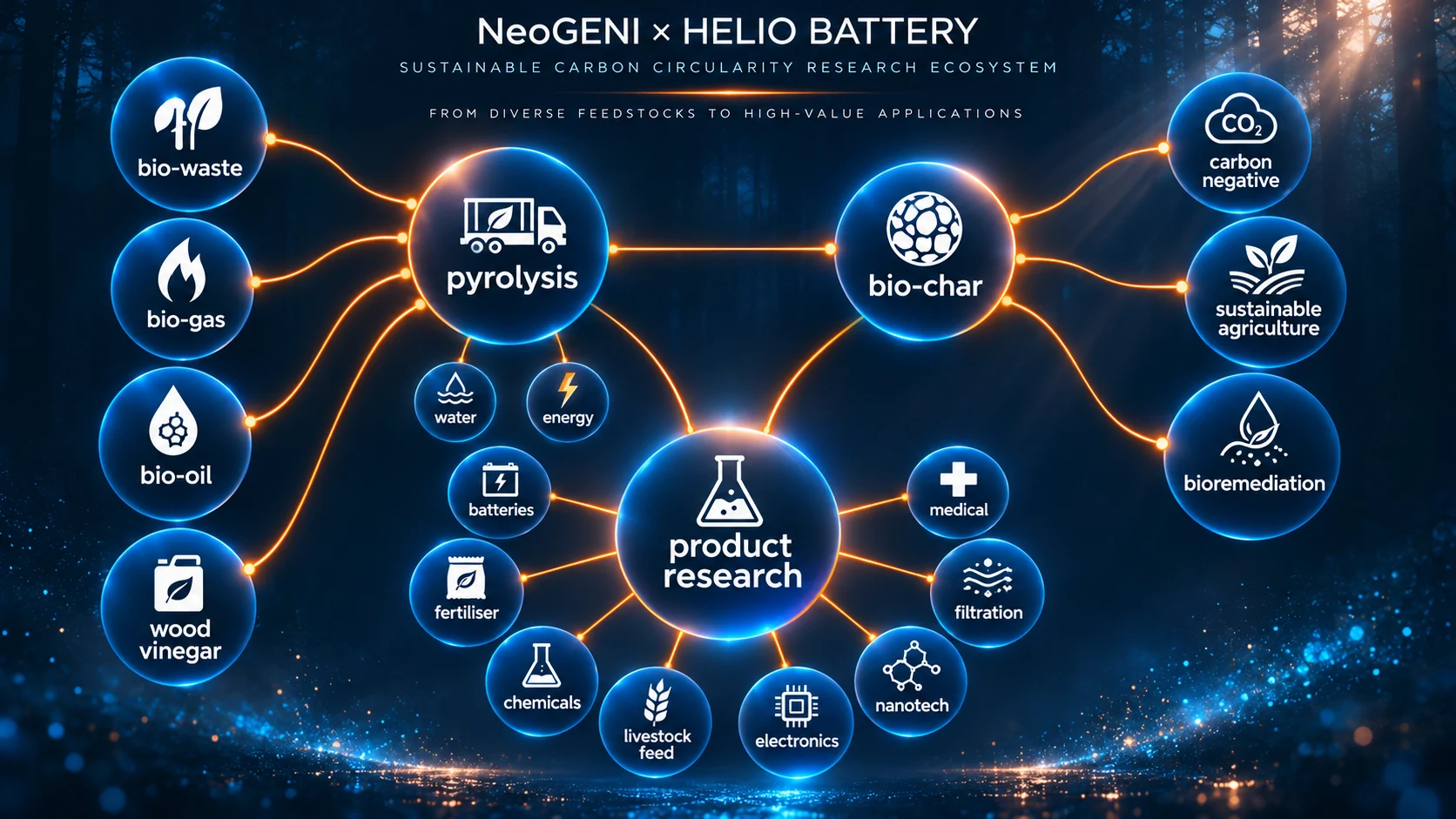
HELIO BATTERY investigates biochar from suitable biomass residues and recovered carbon black from used tyres as distinct HELIONIX carbon streams. The intended graphite, graphene or battery application defines the feedstock, refining and scientific qualification required.
Choose the carbon.
Prove the pathway.
Biochar and tyre-derived recovered carbon black are different starting materials. Explore how end-product requirements guide material selection, graphite and graphene research, and battery qualification.
Start with the required end product.
HELIONIX biochar from suitable biomass residues and recovered carbon black from used tyres are separate carbon feedstocks. The desired product specification determines which input, processing route and qualification tests are appropriate.
Two sources.
Product-led science.
HELIO BATTERY's research encompasses biochar and recovered carbon black as distinct inputs, then investigates suitable routes towards graphite → graphene → battery materials. Feedstock selection is made against the target end-product specifications, not assumed in advance.
SOFOS SCIENCE supports material characterisation, experiment design and evidence-based qualification. NeoGENI connects promising outcomes with future engineering and industrial applications.
Exploratory deuterium and Tetryonics research remains a separate scientific workstream.
Compare biomass-derived biochar with used-tyre recovered carbon black: origin, carbon content, ash, sulphur, metals and structural consistency.
Investigate qualified carbon feedstocks for purification and graphitisation against the required crystalline structure and material grade.
Study potential graphene routes and assess layers, defects, surface chemistry, reproducibility and intended application.
Evaluate eligible electrodes and carbon additives through electrochemical testing, safety analysis and manufacturability assessment.
Feedstocks, science,
and qualification.
NeoGENI connects circular carbon resources with product-led materials research. HELIONIX supplies two distinct candidate feedstocks; HELIO BATTERY investigates which structures and chemistries may meet demanding industrial and battery specifications.
Materials research
for real-world impact.
Carbon science begins with curiosity and advances through characterisation, experimental evidence and repeatable qualification. HELIO BATTERY connects potential materials breakthroughs with practical energy applications.
See our researchFrom discovery
to deployment.
From recovered resources to qualified carbon materials, the next step is connecting research with specialist manufacturers, supply networks and energy markets.
Explore the Industry StoreFrom carbon science
to energy opportunity.
Research sets the direction. Material qualification establishes what is possible. Commercial development then connects eligible graphite, graphene and battery-material candidates to manufacturing partners and customers.